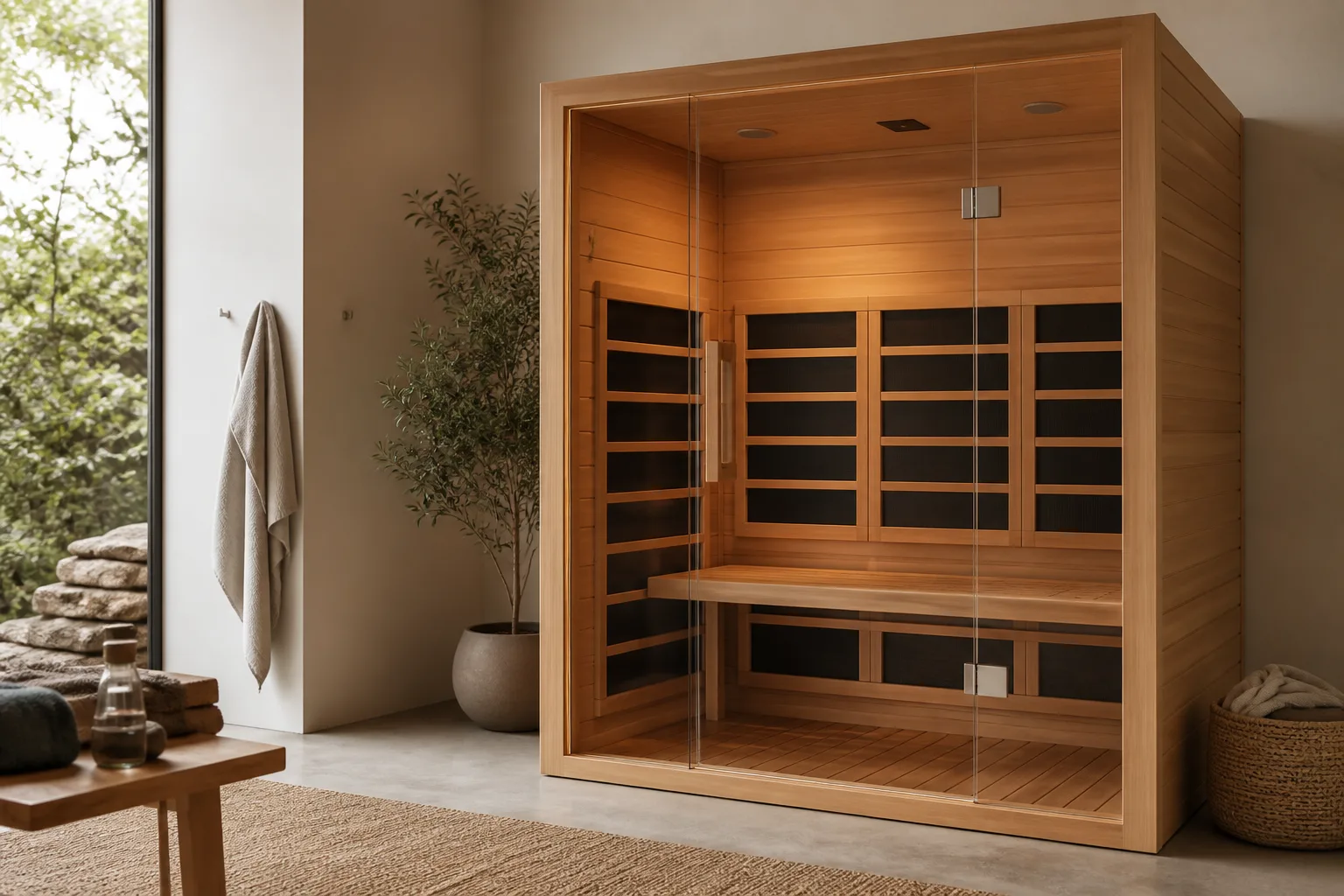
Warmth designed around the seat
An infrared sauna uses radiant heaters positioned around the occupant. That makes the relationship between the bench and the panels central to the buying decision. Look beyond the number of emitters and ask where they sit relative to your back, sides, and legs. A cabin marketed for two people may feel very different with both seats occupied. Compare internal bench width and depth, door access, and panel coverage with the way you actually expect to sit.
Know what the spectrum label means
Far-infrared, near-infrared, and full-spectrum describe different emitter offerings, not a universal quality ranking. Manufacturers use different combinations of components, controls, and wavelengths. Read the specification for the actual model instead of relying on a collection name. Red ambient lighting is not automatically a dedicated red-light device, and an infrared cabin is not automatically a hybrid traditional sauna. Separate each feature on the equipment list so you can compare like-for-like packages.
Choose placement carefully
Most home infrared shopping begins indoors, but there are also models made for outdoor settings. Weather protection must be part of the actual product design. Indoors, review ceiling clearance, floor suitability, proximity to wet areas, ventilation, and the required electrical supply. In a garage or other space with changing temperatures, ask whether the ambient conditions fall within the manufacturer's operating limits. Convenience is valuable only if the intended location supports the cabin throughout the year.
Compare controls and everyday usability
The controls should make the sauna easy to understand. Check which emitters can be selected independently, how the timer operates, and whether accessories are included or optional. If a model advertises remote operation, read the conditions that allow it and any associated safety features. Consider the ease of reaching the door and controls while seated. Lighting, speakers, and decorative features may improve the setting, but they do not replace an appropriate heater layout or comfortable bench.
Read claims with care
Compare measurable specifications rather than broad wellness promises. If electromagnetic-field levels matter to you, request the model-specific report, the measurement distance, and the operating conditions used. A label such as low EMF is not a substitute for that context. Do not use marketing about detoxification, calorie burning, or treatment outcomes as a product specification. For questions about personal suitability, medication, or an existing medical condition, ask a qualified clinician before using a sauna.
Look at the complete ownership picture
An infrared sauna purchase includes more than the enclosure. Review warranty coverage for the cabin, electrical components, heaters, and controls separately, along with access to service and replacement parts. Confirm the model's electrical requirements before delivery rather than relying on the appearance of a plug in a photograph. Compare assembly instructions and the largest panel dimensions with your access route. Choose a size you can comfortably use and maintain, not simply the largest nominal capacity that fits the budget.
Questions Before You Choose
How is an infrared sauna different from a traditional sauna?
Infrared panels deliver radiant heat, while traditional sauna heaters warm the room and stones. The equipment layout, operating conditions, and experience differ; neither description alone establishes the best fit for you.
What is a full-spectrum infrared sauna?
It is a cabin marketed with multiple infrared wavelength ranges. Confirm the actual emitter specifications and controls because full-spectrum packages differ by manufacturer.
Can infrared saunas be installed indoors?
Yes, many are intended for indoor use. Follow the exact model's location, ventilation, clearance, floor, and electrical requirements.
Does low EMF mean zero electromagnetic fields?
No. Ask for model-specific test results, measurement distances, and operating conditions rather than assuming a low-EMF label means zero.
Can I pour water onto infrared heaters?
No. Infrared panels are not sauna stones. Follow the operating manual and keep liquids away from electrical heaters and controls.
Is red lighting the same as red-light therapy equipment?
No. Decorative red lighting and dedicated light devices are different features. Compare the specified equipment rather than the color shown in a product image.
What should I compare between two-person models?
Compare actual bench dimensions, panel placement, entry space, electrical supply, assembly access, and component warranties, not only the stated two-person capacity.