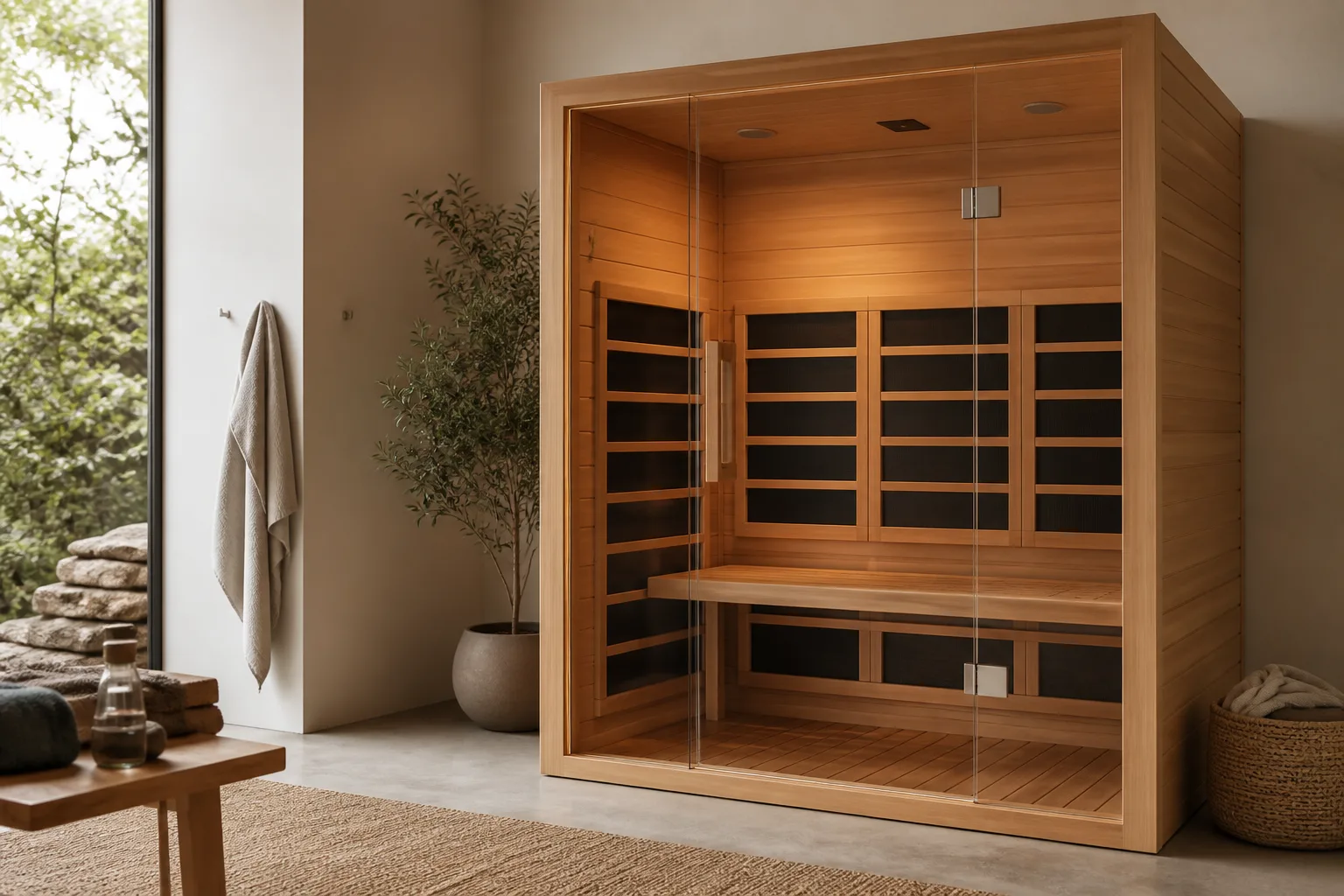
Draw the entire corner footprint
A corner cabin may have an angled entrance and unequal wall lengths. Measure both adjoining walls and the diagonal space in front, then add the required clearances. The saved space can disappear if the open door blocks a nearby room entrance or the normal walking path.
Understand the corner seat
Angled or L-shaped benches can provide several sitting positions, but the inner corner may have different legroom and panel coverage. Compare where each occupant places their feet and shoulders. A corner shell should be judged by its usable interior rather than its ability to tuck neatly against two walls.
Preserve assembly access
Ask which connections must be reached from the sides or back. You may need to assemble the cabin away from its final position before moving it into place, if the manufacturer permits that sequence. Plan for maintenance access so the corner does not become an obstacle to future repairs.
Look at coverage from the seat
Infrared panels should be assessed in relation to where you actually sit. Compare the emitter positions, bench depth, legroom, and access to controls instead of counting panels alone. A specification sheet is most useful when it includes a clear interior drawing that connects the heating equipment with the intended seating positions.
Read model-specific specifications
Infrared product descriptions can use similar terms for different equipment. Ask for the emitter type, operating instructions, electrical requirements, and any test reports relevant to the claim you are comparing. Do not infer medical benefits, exposure levels, or outdoor suitability from a broad product label or a general statement about infrared technology.
Compare the ownership details
Confirm how the cabin is delivered, which parts need assembly, and how panels or controls can be reached for service. Review the written warranty and replacement-part process before ordering. For routine care, follow the instructions for timber, glazing, and electrical panels separately, keeping cleaning liquids away from components that must remain dry.
Questions Before You Choose
Does a corner sauna always save floor space?
No. Compare the full footprint and diagonal door clearance with a rectangular cabin in the same room.
Can it sit flush against both walls?
Only if the model’s ventilation, assembly, and service instructions allow that clearance.
Is the corner seating position comfortable?
It depends on bench geometry and legroom. Use the interior drawing to understand how the angled position is occupied.
Are corner cabins always larger-capacity models?
No. Corner describes the enclosure shape, not a fixed occupant count or bench length.
Do emitters cover the corner equally?
Not automatically. Check the panel layout for the actual seating positions and any shaded or offset areas.
Can the door hinge be changed?
Only where the manufacturer offers or approves that option. Do not assume the angled entrance is reversible.
What should I measure before ordering?
Measure both walls, the diagonal entrance area, ceiling height, door swing, service clearance, and the route for the largest panel.